
HEAT (1995) - Subtext
What'd ya say I buy you a cup of coffee?

In Michael Mann’s Heat, after Detective Vincent Hanna (Al Pacino) fails to bust thief Neil McCauley (Robert De Niro) and his crew, he makes a daring move: he invites McCauley for coffee. It’s a bold, almost desperate pivot in a 170-minute cat-and-mouse epic.
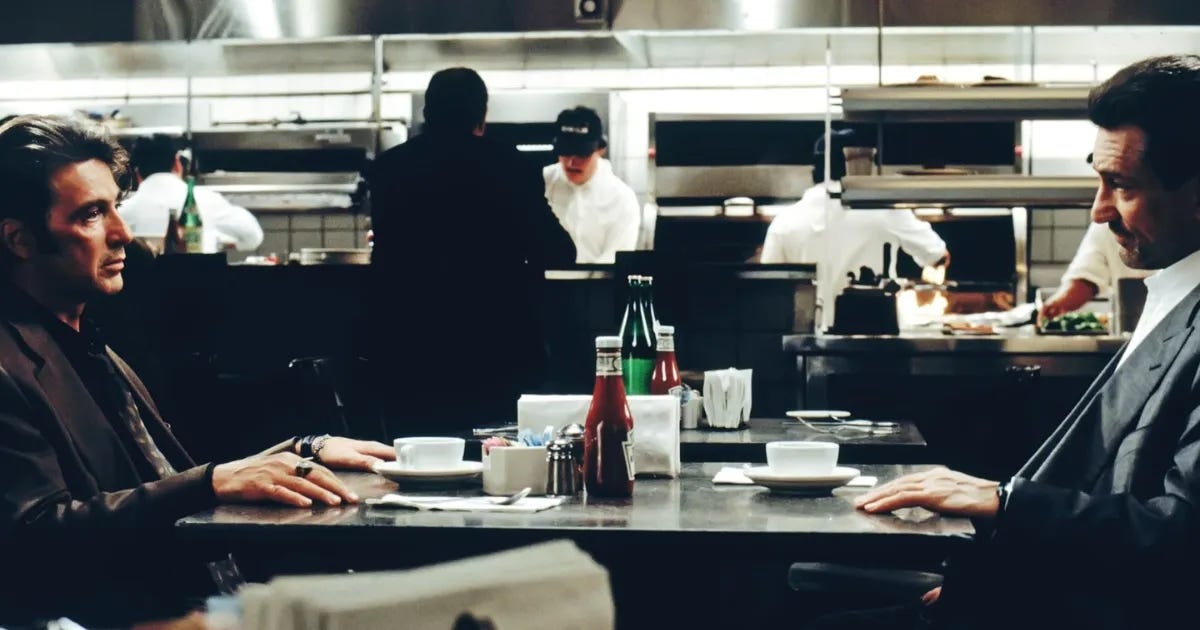
Until the movie's climactic showdown, this is the only time these two titans share the screen or even speak directly. For screenwriters, especially in action, this scene is a masterclass in subverting expectations, building tension through dialogue, and humanizing larger-than-life characters without sacrificing stakes.
The setup alone is electric. Hanna, wired and relentless, pulls over McCauley, the coolly disciplined thief, on a dark freeway. Instead of a shootout, we get an invitation: “Wanna get coffee?” It’s a curveball that feels both inevitable and shocking, a testament to Mann’s knack for grounding operatic crime narratives in raw human moments. As a screenwriter, I’m in awe of how Mann and cinematographer Dante Spinotti frame this encounter: tight close-ups in a sterile diner, the city’s glow blurred outside, forcing us to focus on every microexpression. The blocking mirrors their dynamic. Two men across a table, worlds apart but eerily similar.
The dialogue crackles with authenticity and economy. Hanna opens with what he thinks he knows. McCauley’s rap sheet, his patterns. McCauley counters with his own read on Hanna, pegging him as a man consumed by the chase. They’re both a little wrong, and that’s the point. Mann strips away their myths, letting them see each other as men, not archetypes. “I do what I do best: I take scores. You do what you do best: trying to stop guys like me,” McCauley says. It’s a line that’s become legend, but its power lies in its simplicity. It distills their shared obsession, their inability to walk away. For action writers, this is a reminder: even in a genre of spectacle, a single conversation can carry the weight of a heist or a gunfight.
What makes this scene iconic is its mutual respect. Hanna and McCauley recognize each other’s DNA; two sides of the same coin, bound by discipline and drive. Mann doesn’t let it devolve into cliché bonding; the tension never dissipates. They know one will likely die because of the other, yet there’s an unspoken kinship. This is where Mann’s roots in Miami Vice shine, his ability to infuse hyper-masculine worlds with emotional depth. For screenwriters, it’s a challenge: how do you craft a scene where enemies connect without softening their edges? Mann’s answer is restraint and precision.
Structurally, the scene is a fulcrum. It’s the moment Heat pivots from a procedural chess game to a tragedy of inevitability. Before, we’re caught up in the heists and pursuits; after, we’re invested in these men’s fates.
I learned from this scene how to pause the kinetic energy of a script – car chases, bank jobs – and let characters breathe, revealing stakes that make the action hit harder. Mann’s script doesn’t waste a word, yet it feels effortless, like two guys just talking. That’s the magic. It’s crafted to the bone but plays like life.
I couldn’t have written this scene better. Honestly, I wouldn’t even try. It’s a reminder that in action, the quiet moments can be the loudest. For any writer, Heat’s coffee shop scene is a dare. Take your heroes and villains, strip them to their cores, and let them talk.
If you’ve built them right, the sparks will fly.